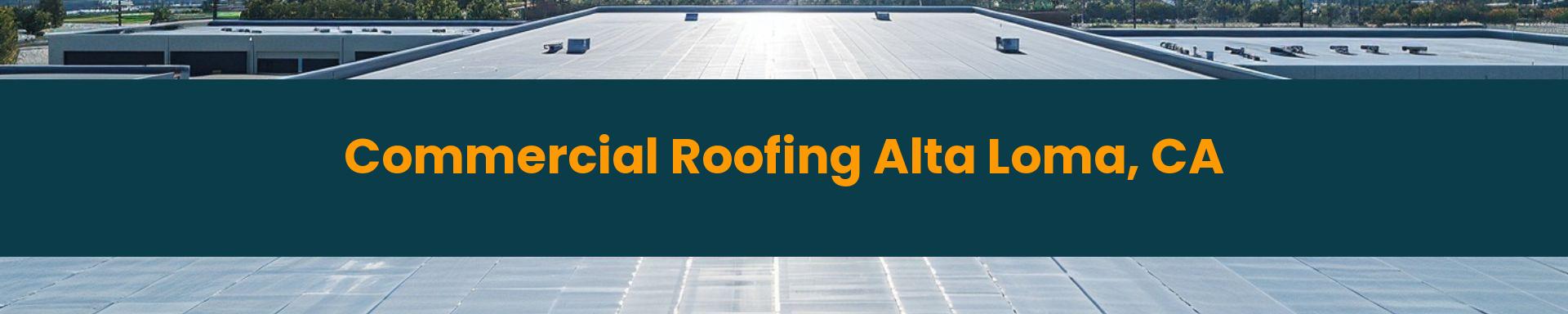
Commercial Roofing Rancho Cucamonga delivers system-led commercial roofing in Alta Loma, California by inspecting, repairing, maintaining, restoring, and replacing commercial roof systems on warehouses, logistics facilities, industrial properties, retail buildings, office properties, multifamily buildings, and other commercial facilities. Commercial Roofing Rancho Cucamonga’s commercial roofing services in Alta Loma are defined around high solar exposure, sustained UV degradation, thermal expansion and contraction across large roof spans, wind-driven dust accumulation, and drainage sensitivity during intermittent rainfall, where membrane fatigue, seam stress, flashing breakdown, and ponding-prone conditions can develop across low-slope commercial roofing systems, ensuring commercial roofing scope is set against verified performance conditions rather than reactive patch repair, isolated leak sealing, or non-system-based maintenance approaches.
The Alta Loma-specific outcomes below show how confirmed commercial roofing conditions are translated into controlled scope, sequenced delivery stability, and verifiable completion records across Inland Empire heat exposure, UV-driven membrane degradation, thermal movement, wind-driven dust accumulation, foothill exposure, and drainage sensitivity during intermittent rainfall.
- Confirmed commercial roofing scope in Alta Loma → identifies membrane fatigue, seam stress, flashing weakness, drainage restriction, roof penetration vulnerability, and substrate condition → commercial roofing targets established system failure drivers rather than surface-level defects or isolated leak symptoms.
- Access and sequencing control for Alta Loma commercial roofing works → coordinates roof access, tenant operations, rooftop equipment zones, material staging, weather windows, and active repair or replacement phases → phased works reduce disruption, uncontrolled exposure, and programme instability.
- Commercial roof system remediation in Alta Loma → restores performance across membranes, flashings, seams, penetrations, drainage points, edge details, insulation layers, and deck interfaces → risk is reduced beyond reactive patch repair or short-term leak sealing.
- Flashing, seam, and penetration correction at Alta Loma commercial roof interfaces → closes water-entry routes at parapets, curbs, vents, skylights, HVAC penetrations, roof edges, and transition details → leak pathways are reduced where commercial roof defects commonly concentrate.
- Commercial roofing system selection for Alta Loma conditions → matches TPO, PVC, EPDM, metal roofing, built-up roofing, modified bitumen, coating, repair, or replacement scope to confirmed exposure, roof condition, building use, and long-term performance need → commercial roofing scope is aligned to actual roof-system risk rather than generic material selection.
- Inspection records and documented closeout for Alta Loma commercial roofing works → creates a traceable record of roof condition, completed scope, installed details, inspection findings, repair notes, and completion status for owner, manager, insurer, tenant, and facility planning requirements → handover, maintenance planning, and long-term asset assurance are supported.
What Commercial Roofing Services Do We Provide In Alta Loma, California?
Commercial Roofing Rancho Cucamonga delivers system-led commercial roofing across San Bernardino County and nearby Inland Empire commercial areas by inspecting, repairing, maintaining, restoring, and replacing roof systems on warehouses, logistics facilities, industrial buildings, retail centers, office properties, multifamily buildings, and other commercial assets. Commercial Roofing Rancho Cucamonga’s services are scoped around high solar exposure, UV-driven membrane ageing, thermal movement across low-slope roof assemblies, dust and debris loading, rooftop equipment demand, drainage sensitivity, and large-span commercial roof behaviour, ensuring each roof system is assessed and corrected against verified performance conditions rather than surface-level defects, isolated leak points, or short-term patch repair.
- Commercial Roof Inspection: system-level roof assessment that verifies membrane condition, seam integrity, flashing performance, drainage behaviour, penetration detailing, insulation risk, substrate condition, and heat-related deterioration across commercial roof assemblies.
- Commercial Roof Repair: targeted correction of active roof defects where solar degradation, thermal movement, puncture damage, flashing failure, open seams, equipment-zone wear, or drainage restriction has compromised roof-system performance.
- Commercial Roof Leak Detection: investigation of water-entry pathways across membranes, laps, penetrations, curbs, drains, scuppers, parapets, and transitions where blocked drainage, dust buildup, and intermittent rainfall can make leak sources difficult to trace.
- Commercial Roof Maintenance: planned roof upkeep that clears debris, validates drainage, checks seams and flashings, reviews rooftop equipment zones, documents roof condition, and corrects early-stage defects before they escalate into leaks or system instability.
- TPO Commercial Roofing: reflective single-ply thermoplastic roofing using heat-welded seams for low-slope commercial buildings exposed to high solar load, UV stress, thermal cycling, and large roof-span movement.
- PVC Commercial Roofing: welded single-ply membrane roofing for commercial environments requiring durable seam performance, chemical resistance, moisture control, and reliable protection around rooftop equipment and operational roof areas.
- EPDM Commercial Roofing: flexible synthetic rubber roofing for commercial roof systems where expansion, contraction, movement tolerance, and long-term waterproofing continuity are critical across low-slope roof areas.
- Commercial Metal Roofing: commercial metal roof installation, repair, coating, and replacement for wide-span buildings where panel movement, fastener performance, flashing continuity, corrosion control, and heat exposure must be managed as a complete roof system.
- Built-Up Roofing: multi-layer asphalt and reinforcement roofing that provides redundant waterproofing protection for low-slope commercial roofs exposed to heat stress, surface wear, drainage load, and long-term weathering.
- Modified Bitumen Roofing: reinforced asphalt membrane roofing designed to handle thermal movement, resist splitting and cracking, and maintain layered protection across low-slope commercial roof assemblies.
- Commercial Roof Coating: fluid-applied roof restoration using reflective and protective coating systems to reduce heat absorption, slow UV degradation, seal suitable roof surfaces, and extend the service life of existing commercial roof assemblies.
- Commercial Roof Replacement: removal and replacement of end-of-life commercial roof systems where membrane failure, saturated insulation, flashing breakdown, drainage failure, substrate weakness, or repeated repair history makes restoration no longer viable.
Need help with an upcoming commercial roofing project?
When Does A Commercial Roof In Alta Loma Require System-Level Commercial Roofing?
Commercial roofing in Alta Loma is required where roof-level investigation confirms that a commercial roof system can no longer reliably resist environmental exposure, discharge water, maintain membrane continuity, or perform under Inland Empire heat load, sustained UV radiation, thermal expansion and contraction, wind-driven dust accumulation, and intermittent rainfall conditions. Across Alta Loma and surrounding areas within San Bernardino County, commercial roofing becomes necessary where membranes, seams, flashings, penetrations, drainage assemblies, insulation layers, edge terminations, and roof decks exhibit verified system-level weakness that extends beyond isolated surface defects and cannot be resolved through reactive patch repair, sealant application, or non-system-based intervention.
The Alta Loma-specific triggers below show when a commercial roof condition becomes a confirmed requirement for system-level commercial roofing.
- Water ingress is occurring through membrane laps, flashing interfaces, roof penetrations, drainage outlets, or edge conditions. The commercial roofing system is no longer maintaining a continuous weather-resistant barrier. Commercial roofing is required to trace the active ingress pathway and reinstate full-system waterproofing continuity.
- Prolonged UV exposure and high solar load have induced membrane embrittlement, surface cracking, shrinkage, blister formation, or coating degradation. The roof covering is no longer resisting radiation-driven deterioration. Commercial roofing is required to stabilise, restore, or replace affected materials before accelerated breakdown propagates across the system.
- Thermal cycling across large roof spans is generating expansion stress, contraction fatigue, seam displacement, flashing detachment, and fastener movement. The commercial roof assembly is losing dimensional stability under temperature fluctuation. Commercial roofing is required to correct movement-induced failure modes before separation develops into water-entry conditions.
- Drainage infrastructure, including internal drains, scuppers, gutters, and discharge paths, is obstructed, undersized, misaligned, or forming ponding zones after rainfall. Water is not evacuating the roof surface under controlled flow conditions. Commercial roofing is required to re-establish effective drainage performance and prevent load concentration, saturation, and membrane stress.
- Penetration clusters and rooftop equipment zones, such as HVAC curbs, pipe supports, service conduits, skylights, and vent assemblies, are exhibiting flashing breakdown, membrane abrasion, or repeated leakage. Failure is concentrating at high-interaction interfaces. Commercial roofing is required to re-secure these transition points and restore continuity across critical detailing zones.
- The existing commercial roof system no longer aligns with operational, tenancy, insurance, energy-efficiency, or lifecycle requirements. System configuration, material selection, or performance grade is no longer fit for purpose. Commercial roofing is required to upgrade, reconfigure, or replace the roof assembly in line with current building demands.
- Previous repair interventions, including patching, sealant application, or partial coating, have failed to resolve recurring leakage or system instability. The underlying failure mechanism remains active within the membrane, flashing network, drainage relationship, or substrate condition. Commercial roofing is required to eliminate root-cause defects rather than extend short-term repair cycles.
- Commercial roof scope cannot be determined from surface inspection, historic repair records, or interior leak manifestation alone. The true system condition remains indeterminate until membrane integrity, insulation moisture content, drainage capacity, flashing performance, and deck stability are verified through structured assessment. Commercial roofing is required once investigation confirms coordinated system-level failure.
In Alta Loma, commercial roofing is required once investigation verifies that water ingress, UV-driven material degradation, thermal movement stress, drainage failure, flashing breakdown, membrane discontinuity, equipment-interface damage, insulation saturation, or substrate instability cannot be resolved through isolated repair, making system-level commercial roofing necessary to restore controlled, durable, and performance-aligned roof protection.
Need help with an upcoming commercial roofing project?
What Problems Does Commercial Roofing Solve In Alta Loma?
Commercial roofing in Alta Loma solves roof-system failure where water ingress, UV-driven material degradation, thermal movement stress, drainage underperformance, flashing discontinuity, equipment-interface weakness, insulation saturation, or substrate instability prevent a commercial roof from maintaining controlled, durable, and performance-aligned protection. Across Alta Loma and surrounding San Bernardino County communities, commercial roofing is used to resolve failure in warehouses, logistics facilities, industrial properties, retail buildings, office properties, and multifamily structures where sustained solar exposure, Inland Empire heat cycles, wind-driven dust, foothill exposure, rooftop equipment loads, and intermittent rainfall can concentrate breakdown at membranes, seams, flashings, penetrations, drains, scuppers, edge details, insulation layers, and roof decks.
The Alta Loma-specific problems below show what commercial roofing resolves when roof-system failure cannot be controlled through patch repair, sealant application, isolated leak response, or non-system-based maintenance alone.
- Water ingress through the commercial roofing system. Moisture is entering through membrane laps, flashing interfaces, penetrations, drainage outlets, or edge conditions because the Alta Loma roof assembly has lost continuous weather protection. This condition is resolved by tracing the active ingress pathway and reinstating full-system waterproofing continuity.
- UV-driven membrane degradation across exposed roof areas. Alta Loma solar exposure accelerates embrittlement, cracking, shrinkage, blistering, chalking, and coating failure across low-slope commercial roofs. Restoration or replacement of degraded surfaces stabilises the roof system against ongoing radiation-driven deterioration.
- Thermal movement across large commercial roof spans. Inland Empire temperature variation introduces expansion stress, contraction fatigue, seam displacement, flashing detachment, and fastener movement across wide roof areas. System-level correction restores dimensional stability where separation would otherwise develop into leak conditions.
- Drainage restriction following intermittent rainfall events. Wind-driven dust, debris accumulation, blocked drains, restricted scuppers, and low-slope geometry can create persistent ponding across Alta Loma commercial roofs. Re-establishing controlled water discharge prevents load concentration, saturation, and membrane stress.
- Failure at rooftop equipment and service interfaces. HVAC curbs, pipe supports, skylights, vents, and service-access zones introduce repeated membrane abrasion, flashing gaps, and puncture risk across operational roof areas. Reinforcement of these high-interaction zones restores protection where commercial roof defects most frequently originate.
- Flashing breakdown at parapets, curbs, walls, and transition details. Foothill wind exposure, thermal movement, and ageing materials can open vulnerable junctions at critical roof interfaces. Reconnecting flashing continuity eliminates water-entry routes concentrated at transition points.
- Insulation saturation beneath the visible roof layer. Trapped moisture within insulation reduces thermal performance, distorts drainage behaviour, and sustains concealed leak conditions across Alta Loma commercial roofing systems. Removal of saturated materials and reinstatement of a stable roof build-up restores performance integrity.
- Substrate and roof deck instability below the membrane system. Prolonged exposure, moisture intrusion, fastening failure, corrosion, or structural deflection can compromise the base supporting the commercial roof assembly. Addressing underlying deck conditions ensures the restored roof system performs reliably under load and exposure.
- Recurring leak cycles following repeated patch repairs. Localised fixes fail to resolve the underlying Alta Loma roof-system failure mechanism when drainage, movement, or continuity issues remain active. System-level remediation replaces symptom-led repair with verified correction of root-cause defects.
- Commercial roof systems that no longer meet operational or lifecycle requirements. Existing roofs may fall short of tenant expectations, insurance standards, energy performance targets, or long-term asset management goals. Aligning the roof system with actual building use restores performance, compliance, and lifecycle reliability.
In Alta Loma, commercial roofing resolves the underlying roof-system problems behind water ingress, UV degradation, thermal movement, drainage restriction, flashing failure, equipment-interface damage, insulation saturation, substrate instability, and recurring repair failure, making it the system-level route to controlled, durable, and performance-aligned roof protection when isolated repair is no longer sufficient.
Need help with an upcoming commercial roofing project?
Does Your Building In Alta Loma Need Commercial Roofing?
A building in Alta Loma needs commercial roofing when verified roof-level assessment shows that the existing commercial roof system can no longer reliably resist environmental exposure, discharge water, maintain membrane continuity, or perform under Inland Empire heat load, sustained UV radiation, thermal expansion and contraction, wind-driven dust accumulation, and intermittent rainfall conditions. In Alta Loma, this most often affects warehouses, logistics facilities, industrial buildings, retail properties, office buildings, and multifamily structures across Alta Loma and surrounding San Bernardino County areas, where prolonged solar exposure, temperature variation, rooftop equipment loads, and low-slope roof design can intensify failure at membranes, seams, flashings, penetrations, drainage systems, insulation layers, edge details, and roof decks. Where water ingress is confirmed through membrane laps, flashing interfaces, penetrations, drains, scuppers, or edge conditions, commercial roofing in Alta Loma becomes necessary because the roof assembly is no longer maintaining continuous weather protection across the building envelope. Where sustained UV exposure has driven membrane embrittlement, cracking, shrinkage, blistering, or coating breakdown, commercial roofing becomes necessary because the existing roof surface can no longer resist ongoing material degradation. Where thermal movement across large roof spans is creating seam separation, flashing detachment, fastener movement, or edge instability, system-level correction becomes necessary because isolated repair cannot restore dimensional continuity.
Where drainage systems are blocked, undersized, misaligned, or forming ponding zones after rainfall, commercial roofing becomes necessary because water is not being discharged under controlled conditions and is instead increasing load, saturation risk, and membrane stress. Where rooftop equipment zones, including HVAC systems, service penetrations, skylights, and access areas, are showing repeated membrane damage, flashing failure, or leak activity, commercial roofing becomes necessary because these high-interaction zones cannot be stabilised through patch repair alone. Where insulation saturation, concealed moisture accumulation, or substrate instability is present beneath the visible roof surface, commercial roofing becomes necessary because underlying system failure cannot be corrected without coordinated intervention. Where previous repairs, coatings, or localised interventions have failed to eliminate recurring leaks or system instability, commercial roofing is required because the underlying failure mechanisms remain active within the membrane, flashing network, drainage performance, or structural substrate. Commercial Roofing Rancho Cucamonga assesses buildings in Alta Loma against verified roof-system evidence so the next step is determined by actual failure behaviour, environmental exposure, and performance requirements rather than surface wear, historic patching, or incomplete inspection data. If your building in Alta Loma has unresolved roof leaks, recurring drainage issues, membrane breakdown, flashing failure, insulation concerns, or uncertainty over whether the existing commercial roof system can remain in service, request a commercial roofing assessment to identify the correct repair, maintenance, or replacement pathway.