
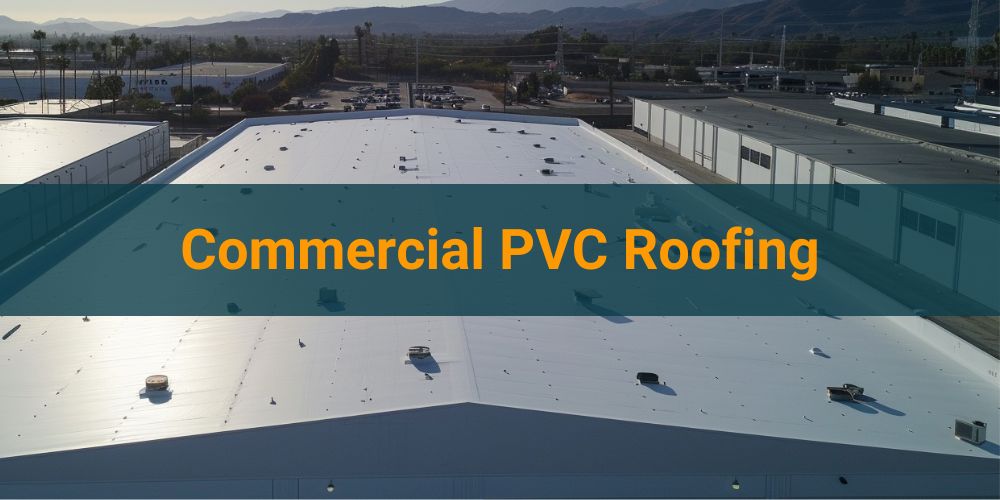
Commercial Roofing Rancho Cucamonga provides commercial PVC roofing repair, replacement, and maintenance for flat and low-slope commercial buildings across Rancho Cucamonga, California. PVC roofing systems in Rancho Cucamonga operate under high UV exposure, daily thermal expansion and contraction, and dust-driven drainage conditions that directly affect membrane flexibility, seam integrity, and long-term waterproofing performance across warehouses, retail units, office buildings, and multi-tenant commercial properties. Commercial PVC roofing systems use a single-ply polyvinyl chloride membrane with heat-welded seams to create a continuous waterproofing layer. In Rancho Cucamonga conditions, system performance is determined by how the membrane responds to UV-driven ageing, thermal movement across large roof spans, and drainage behaviour under dust accumulation and ponding risk.
- High UV exposure in Rancho Cucamonga → accelerates plasticiser loss within PVC membranes → membrane flexibility reduces over time and surface brittleness develops → cracking, splitting, and premature leak formation increase across exposed roof areas.
- Daily thermal expansion and contraction across flat commercial roofs → places continuous stress on heat-welded seams and membrane junctions → seam fatigue and weld degradation develop if not maintained → seam separation becomes a primary water ingress pathway affecting interior spaces and insulation layers.
- Dust and debris accumulation across low-slope roofs in Rancho Cucamonga → restricts drainage flow and blocks outlets and scuppers → ponding water forms across membrane surfaces → sustained water pressure accelerates seam stress, membrane deformation, and recurring leak conditions.
- Commercial rooftop conditions including penetrations, equipment zones, and service interfaces → create concentrated stress points within the PVC system → flashing breakdown and weld inconsistency develop at junctions → localised failures expand into multi-point leak conditions if not corrected at system level.
Commercial Roofing Rancho Cucamonga delivers commercial PVC roofing as a system-level service, assessing membrane condition, weld integrity, flashing interfaces, penetrations, drainage performance, and environmental exposure before defining the correct repair, restoration, maintenance, or full PVC roof replacement strategy.
What Commercial PVC Roofing Systems Does Commercial Roofing Rancho Cucamonga Service?
Commercial Roofing Rancho Cucamonga services commercial PVC roofing systems across flat and low-slope buildings where performance depends on membrane flexibility, heat-welded seam integrity, attachment stability, and drainage behaviour under Rancho Cucamonga’s high UV exposure, daily thermal cycling, and dust-driven drainage conditions. PVC roofing systems are not treated as uniform installations. Each configuration responds differently to environmental stress, which directly affects waterproofing performance, failure risk, and service life.
The PVC roofing system configurations serviced by Commercial Roofing Rancho Cucamonga include:
- Mechanically attached PVC roofing systems → membrane is secured using fasteners across large flat roof spans common in Rancho Cucamonga warehouses and commercial buildings → thermal expansion and contraction places repeated stress on fastening points and welded seams → seam fatigue, fastener movement, and membrane displacement develop over time → water ingress risk increases at seams and attachment zones if not controlled.
- Fully adhered PVC roofing systems → membrane is bonded directly to the substrate across the roof assembly → performance depends on adhesion strength under heat exposure and substrate condition → Rancho Cucamonga heat cycles and surface ageing weaken bond integrity over time → membrane lifting, bubbling, or separation creates concealed water ingress pathways beneath the system.
- PVC roofing systems with high rooftop penetration density → HVAC units, vents, service lines, and equipment create multiple flashing and seam junctions → each penetration introduces a high-stress interface under thermal movement and UV exposure → flashing breakdown and weld inconsistencies develop at these junctions → localised leaks expand into multi-point failure conditions affecting interior spaces and equipment.
- PVC roofs exposed to restricted drainage and ponding conditions → dust and debris accumulation in Rancho Cucamonga blocks drains, scuppers, and outlets → standing water forms across low-slope roof areas → sustained water pressure accelerates seam fatigue and membrane deformation → recurring leaks and accelerated system ageing develop across the roof assembly.
- PVC roofing systems exposed to UV-driven ageing → prolonged solar exposure reduces plasticiser content within the membrane → flexibility decreases and surface brittleness develops over time → cracking, seam stress, and material fatigue increase across exposed areas → premature failure risk rises if the system is not maintained or restored.
- Ageing or previously repaired PVC roofing systems → repeated repairs, patching, and membrane degradation create inconsistent system performance → seams, patches, and original membrane areas respond differently under thermal movement and moisture exposure → failure patterns become unpredictable and spread across the roof → targeted repair becomes less effective and replacement risk increases.
Commercial Roofing Rancho Cucamonga evaluates each PVC roofing system based on configuration, environmental exposure, seam performance, attachment method, drainage behaviour, and overall system condition. This ensures that repair, maintenance, restoration, or replacement decisions are aligned with how the PVC roofing system actually performs under Rancho Cucamonga conditions, rather than applying generic solutions across different system types.
Need help with an upcoming commercial roofing project?
What Causes Commercial PVC Roof Failure in Rancho Cucamonga?
Commercial PVC roof failure in Rancho Cucamonga is driven by the interaction between high UV exposure, daily thermal expansion and contraction, dust-driven drainage restriction, and large-span commercial roof geometry. These conditions act simultaneously on PVC membranes, seams, attachment systems, and flashing interfaces, creating compound stress across the roofing assembly. Failure does not originate from isolated visible defects. It develops through progressive breakdown at seams, material fatigue under heat exposure, drainage overload, and concealed moisture movement beneath the membrane. Commercial Roofing Rancho Cucamonga identifies these failure mechanisms as system-level conditions to prevent localised defects from escalating into multi-point leak activation and full assembly deterioration.
The primary causes of commercial PVC roof failure in Rancho Cucamonga include:
- Thermal cycling-induced seam fatigue across wide-span roofs → Rancho Cucamonga’s day-to-night temperature swings create repeated expansion and contraction across large commercial roof areas such as warehouses and retail units → heat-welded PVC seams are subjected to continuous tensile and shear stress along their length → weld bonds weaken incrementally at a microscopic level before visible separation occurs → seam integrity fails under load, allowing water to penetrate directly into the roofing system and activate leaks across connected membrane zones.
- UV-driven plasticiser loss and membrane embrittlement → sustained solar exposure in Rancho Cucamonga accelerates plasticiser migration out of PVC membranes → membrane flexibility reduces and the material transitions from elastic to brittle behaviour → the membrane becomes less capable of accommodating thermal movement and stress concentration at seams and penetrations → cracking, surface fracture, and weld-line failure develop under normal operating conditions, increasing vulnerability to water ingress.
- Dust accumulation leading to drainage system restriction → airborne dust and particulate typical of Rancho Cucamonga settle across flat commercial roofs and concentrate at drainage points → internal drains, scuppers, and flow paths become partially obstructed → rainfall is retained across the roof surface instead of being discharged efficiently → prolonged ponding introduces continuous hydrostatic pressure on seams, membranes, and flashing interfaces → water is forced through weak points, accelerating leak formation and membrane degradation.
- Hydrostatic pressure amplification across ponding zones → low-slope commercial roof designs rely entirely on unobstructed drainage performance → when drainage is restricted, even moderate rainfall creates standing water across large membrane areas → static water load applies sustained pressure at seam lines, membrane joints, and penetrations → weak welds and micro-defects are forced open under pressure → water enters the system and spreads laterally beneath the membrane, creating concealed multi-point failure conditions.
- Mechanical attachment stress and fastener movement → mechanically attached PVC systems transfer thermal and wind-induced movement into fastening points across the roof deck → repeated expansion, contraction, and wind loading in Rancho Cucamonga cause fasteners to loosen or shift within the substrate → membrane tension redistributes unevenly across fastening rows → stress concentrates at seams and adjacent membrane areas → progressive displacement leads to seam failure, membrane distortion, and increased susceptibility to uplift and water ingress.
- Flashing failure at high-movement penetration zones → rooftop equipment such as HVAC systems, vents, and service penetrations create fixed points within a moving membrane system → thermal expansion and contraction cycles concentrate stress at these interfaces → welded flashing details weaken as movement exceeds material tolerance → small discontinuities form at junctions and transition points → water bypasses the membrane surface and enters directly at penetrations, spreading into insulation and substrate layers.
- Adhesion breakdown in heat-affected and moisture-exposed substrates → fully adhered PVC systems depend on consistent bond strength between membrane and substrate → elevated surface temperatures combined with substrate moisture reduce adhesive performance over time → bond failure develops in localised zones beneath the membrane → separation allows air and water to move beneath the membrane layer → concealed moisture migration and loss of membrane stability lead to progressive system-wide deterioration.
- Moisture ingress followed by lateral migration within the assembly → water entering through seams, penetrations, or flashing defects becomes trapped within insulation layers due to the impermeable nature of PVC membranes → heat exposure drives moisture movement laterally beneath the membrane rather than allowing evaporation → saturated insulation loses thermal performance and structural integrity → deterioration spreads beyond the original entry point → visible leaks appear in multiple locations disconnected from the initial failure source, complicating repair and accelerating system breakdown.
- Incompatible or improperly executed prior repairs → previous interventions using non-compatible materials or inconsistent welding techniques create discontinuities within the roofing system → repaired areas respond differently to thermal movement and UV exposure compared to the original membrane → stress concentrates at material transition zones → failure initiates at the edge of repairs rather than within them → repeat leak cycles develop, often misidentified as new defects rather than system incompatibility.
Commercial Roofing Rancho Cucamonga analyses PVC roof failure as a result of interacting environmental stress, material behaviour, and system configuration rather than isolated defects. By identifying how UV exposure, thermal movement, drainage restriction, and moisture migration combine across large commercial roof assemblies, failure conditions can be resolved at source. This prevents isolated defects from evolving into multi-point leak activation, concealed saturation, and full system deterioration across Rancho Cucamonga commercial properties.
Need help with an upcoming commercial roofing project?
How Are Commercial PVC Roof Leaks Diagnosed in Rancho Cucamonga?
Commercial PVC roof leak diagnosis in Rancho Cucamonga is a system-level process that identifies how water enters, migrates, and accumulates within the roofing assembly under conditions of high UV exposure, thermal cycling, and dust-restricted drainage. Visible leaks rarely indicate the true point of failure. Water typically enters at one location and travels laterally beneath the membrane before becoming visible inside the building. Commercial Roofing Rancho Cucamonga diagnoses PVC roofing systems by isolating entry points, mapping moisture spread, and evaluating seam integrity, attachment stability, and drainage performance across the entire roof assembly.
Commercial Roofing Rancho Cucamonga diagnoses PVC roof leaks using the following controlled process:
- Moisture detection and saturation mapping across the roof assembly → infrared scanning and capacitance-based moisture detection are used during appropriate thermal conditions to identify temperature differentials within insulation layers → wet insulation retains heat differently from dry areas, creating detectable thermal patterns → moisture presence is mapped across the roof surface, including areas with no visible defects → concealed saturation zones are identified before repair begins, preventing misdiagnosis of isolated leaks.
- Seam integrity testing along heat-welded membrane joints → probe testing and mechanical seam inspection are carried out across all welded lap joints under controlled conditions → weakened welds exhibit reduced resistance to probing pressure and show early-stage separation not visible at surface level → seam continuity is evaluated across high-stress zones, including ponding areas and thermal movement lines → compromised seams are identified as primary water entry points even where no active leak is visible.
- Drainage performance assessment under real flow conditions → drains, scuppers, and flow paths are tested and inspected for restriction caused by dust accumulation typical of Rancho Cucamonga conditions → low points and ponding zones are identified through visual inspection and flow simulation → areas where water remains on the roof surface are mapped as hydrostatic pressure zones → these zones are correlated with seam and membrane stress areas to determine where water is being forced into the system.
- Penetration and rooftop equipment interface inspection → HVAC units, vents, service penetrations, and equipment curbs are examined as fixed points within a moving membrane system → flashing welds and transition details are inspected for micro-failure caused by thermal movement and UV exposure → minor discontinuities at these interfaces are identified as high-probability ingress points → water entry at penetrations is confirmed even where internal leaks appear distant from the source.
- Membrane condition analysis under UV and thermal exposure → PVC membrane surfaces are assessed for embrittlement, plasticiser loss, and surface fracture caused by sustained solar exposure in Rancho Cucamonga → brittle membranes exhibit reduced flexibility and micro-cracking under stress → these conditions are mapped against seam and penetration locations to identify failure-prone zones → areas at risk of imminent failure are identified before active leaks occur.
- Attachment system and fastener stability evaluation → mechanically attached PVC systems are inspected at fastening rows and perimeter zones where thermal movement and wind exposure concentrate load → fastener loosening, plate movement, and membrane tension distortion are identified through physical inspection and pattern analysis → displacement patterns indicate stress redistribution across the membrane → these conditions are linked to seam fatigue and progressive failure pathways.
- Moisture migration path tracing within the roofing system → identified saturation zones are analysed in relation to roof slope, membrane layout, and drainage direction → water movement beneath the membrane is traced from entry points to areas of accumulation → internal leak locations are compared with roof-level data to determine migration distance and direction → the original point of entry is isolated even when it is not directly above the visible leak.
- Correlation of internal leak symptoms with external failure points → interior water staining, ceiling damage, or equipment exposure is mapped against roof-level defect and moisture data → discrepancies between internal leak position and external defect location are analysed → lateral moisture spread beneath the membrane is confirmed as the cause of displacement → repair scope is defined based on actual entry points rather than visible interior symptoms.
- Evaluation of prior repairs and material compatibility → previously repaired areas are inspected for material mismatch, weld inconsistency, and transition stress under Rancho Cucamonga thermal conditions → incompatible repairs show differential movement and accelerated failure at edges → these zones are identified as recurring leak origins → failure is attributed to system inconsistency rather than isolated defect recurrence.
Commercial Roofing Rancho Cucamonga diagnoses PVC roof leaks by analysing how water interacts with the roofing system under Rancho Cucamonga’s specific environmental conditions rather than relying on visible symptoms alone. By combining moisture detection, seam testing, drainage analysis, and system-wide correlation, leak sources are identified at their true origin. This prevents repeated patch repairs, eliminates concealed moisture spread, and ensures that repair, restoration, or replacement decisions are based on actual system behaviour across the entire commercial roof assembly.
Need help with an upcoming commercial roofing project?
How Do PVC Roof Inspection Findings Translate Into Repair or Replacement Decisions in Rancho Cucamonga?
Commercial PVC roof inspection findings in Rancho Cucamonga must be translated into clear repair, restoration, or replacement decisions based on how moisture behaviour, seam integrity, membrane condition, and drainage performance interact under high UV exposure, daily thermal cycling, and dust-driven drainage restriction. Inspection data is not diagnostic on its own. Moisture mapping, seam testing, and membrane analysis define whether the roofing system remains stable, is degrading under environmental stress, or has entered a failure state where repair is no longer viable. Commercial Roofing Rancho Cucamonga converts inspection results into defined decision thresholds to ensure each intervention aligns with actual system condition and long-term performance requirements.
Inspection findings are interpreted as decision triggers, not isolated observations.
- Isolated Moisture Without Lateral Migration → Repair Remains Viable.
Moisture is confined to small areas near seams, penetrations, or drainage points → insulation and substrate remain structurally stable with no evidence of spread → the roofing system is still performing as a continuous assembly → targeted repair combined with moisture removal is sufficient → if addressed at this stage, water ingress is eliminated without requiring restoration or replacement. - Early Seam Weakening With Flexible Membrane → Reinforced Repair Required.
Seam testing identifies reduced weld strength but no full separation → PVC membrane retains elasticity despite UV exposure → failure is developing at stress lines rather than across the system → seam re-welding and reinforcement are required to maintain continuity → if left untreated, thermal cycling will convert micro-failure into open seam separation and active leak pathways. - Moisture Spread Across Multiple Zones → Repair Alone Becomes Insufficient.
Moisture mapping confirms lateral migration beneath the membrane beyond the original entry point → insulation layers are becoming saturated across wider areas → the system is no longer locally stable → repair-only intervention will trap moisture and allow continued deterioration → corrective action must include moisture removal and broader system intervention, often progressing toward restoration or partial replacement. - Persistent Ponding and Drainage Restriction → System-Level Correction Required Before Repair.
Dust accumulation and blocked outlets create standing water across low-slope roof areas → hydrostatic pressure is continuously applied to seams, penetrations, and flashing interfaces → even minor defects are forced open under sustained load → membrane repairs alone will fail if drainage conditions remain unchanged → drainage correction becomes mandatory alongside any repair or restoration work. - Membrane Embrittlement From UV Exposure → Restoration or Replacement Threshold.
PVC membrane exhibits plasticiser loss, reduced flexibility, and surface brittleness under prolonged Rancho Cucamonga UV exposure → the material can no longer accommodate thermal expansion and contraction → cracking, seam stress, and fracture risk increase system-wide → localised repair loses effectiveness → restoration may be viable if degradation is moderate, but replacement becomes necessary once brittleness is widespread. - Attachment Instability and Fastener Movement → Structural Correction Required.
Inspection identifies fastener loosening, plate movement, or membrane distortion in mechanically attached systems → thermal and environmental loads are no longer evenly distributed → stress concentrates at seams and adjacent membrane zones → system instability develops under continued cycling → attachment correction is required, and if instability is widespread, partial or full replacement becomes necessary. - Inconsistent Prior Repairs → Loss of System Continuity.
Multiple repair areas using incompatible materials or inconsistent welding techniques create differential movement under UV exposure and thermal cycling → stress concentrates at transition zones between original membrane and repair sections → failure initiates at repair boundaries → ongoing patching becomes unreliable → replacement becomes the correct solution when system continuity cannot be restored. - Widespread Saturation and Multi-Point Failure → Full Replacement Required.
Moisture mapping confirms extensive saturation across insulation layers combined with seam failure, membrane degradation, and drainage issues → defects are interconnected and no longer isolated → the roofing system has lost its ability to perform as a watertight assembly → repair and restoration are no longer viable → full PVC roof replacement is required to eliminate failure pathways and restore long-term performance.
Commercial Roofing Rancho Cucamonga interprets PVC roof inspection findings as defined system states under Rancho Cucamonga-specific environmental stress. By converting moisture behaviour, seam condition, membrane performance, and drainage function into clear decision thresholds, repair, restoration, and replacement strategies are applied with precision. This prevents misdiagnosis, eliminates ineffective repairs, and ensures commercial PVC roofing systems are managed according to their true condition, exposure risk, and remaining service life.
When Should a Rancho Cucamonga Property Request a Commercial PVC Roofing Assessment?
A Rancho Cucamonga commercial property should request a commercial PVC roofing assessment when leaks, seam defects, membrane ageing, drainage problems, repeated repairs, or uncertainty around roof condition begin to affect waterproofing reliability. Commercial PVC roof failure is rarely caused by one visible issue alone. It typically develops through combined system conditions such as heat-welded seam fatigue, UV-driven plasticiser loss, membrane embrittlement, flashing breakdown, drainage restriction, and moisture migration beneath the PVC membrane. In Rancho Cucamonga, high UV exposure, daily thermal expansion and contraction, airborne dust accumulation, and low-slope drainage sensitivity accelerate these failure conditions. Left unaddressed, these factors increase the likelihood of seam separation, surface cracking, ponding water pressure, weld degradation, hidden insulation saturation, and progressive system breakdown. As deterioration advances, defects can move from localised PVC repair issues into wider system failure risks that require restoration, partial replacement, or full PVC roof replacement. Commercial Roofing Rancho Cucamonga evaluates PVC roofing systems as complete assemblies, assessing membrane flexibility, weld integrity, seams, flashing interfaces, penetrations, rooftop equipment zones, drainage performance, moisture presence, attachment stability, and prior repair compatibility. This allows repair, restoration, maintenance, or replacement decisions to be aligned with the actual condition of the PVC roof rather than visible symptoms alone. Engaging Commercial Roofing Rancho Cucamonga at the point of early leak detection, recurring repair issues, ponding water, membrane brittleness, seam weakness, or uncertainty around remaining service life prevents escalation into concealed saturation, internal water damage, operational disruption, and premature full system replacement. Delayed intervention increases repair complexity, expands moisture-affected zones, and raises long-term cost and risk across the building. If your Rancho Cucamonga commercial property has active leaks, repeated PVC roof repairs, ponding water, membrane cracking, seam separation, flashing defects, or uncertainty around whether the PVC roof requires repair, restoration, or replacement, request a commercial PVC roofing assessment from Commercial Roofing Rancho Cucamonga to define the correct next step based on system condition, environmental exposure, and building requirements.