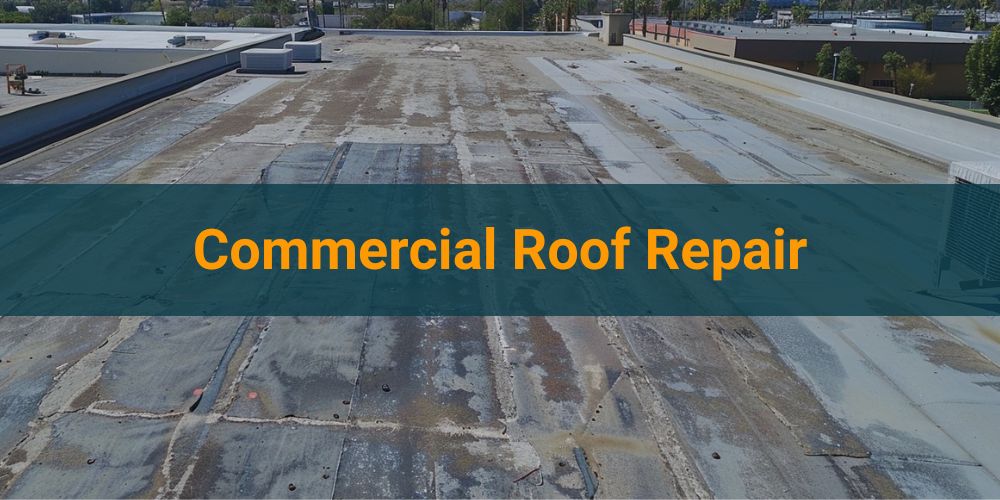
Commercial Roofing Rancho Cucamonga provides commercial roof repair services across Rancho Cucamonga, California, correcting active leaks, isolated roof defects, seam failures, flashing breakdown, punctures, fastener leaks, drainage-related damage, and localised deterioration on flat and low-slope commercial roofing systems. Commercial roof repair is the correct service when the roof remains fundamentally serviceable but defined failure points require targeted correction to restore watertight performance. Commercial roof repair is a corrective intervention, not general maintenance, surface coating, full restoration, or roof replacement. Maintenance is used to reduce future defect risk. Roof coatings are used to extend the life of suitable roof surfaces. Restoration is used when wider system renewal is required. Replacement is required when the roof has lost overall serviceability. Commercial Roofing Rancho Cucamonga performs commercial roof repair when defects remain localised, moisture spread is limited, the substrate remains stable, and the wider roofing assembly can continue performing after the damaged areas are corrected. In Rancho Cucamonga, commercial roof repair demand is commonly caused by high UV exposure, daily thermal expansion and contraction, airborne dust accumulation, rooftop equipment activity, and low-slope drainage sensitivity. These conditions create repairable failure points across TPO, PVC, EPDM, metal, modified bitumen, and coated roofing systems, including seam splits, brittle membrane sections, flashing movement, fastener leaks, punctures, ponding-related stress, cracked surfaces, and damaged penetration details. Commercial Roofing Rancho Cucamonga repairs commercial roofs by identifying the failure source, confirming whether the defect is isolated or spreading, correcting the affected roofing component, and restoring waterproofing continuity without replacing roof areas that remain serviceable. Repair stops being the correct option when moisture has spread through the assembly, defects are repeated across multiple zones, the substrate is unstable, or the roofing system has reached end-of-life condition.
Commercial roof repair in Rancho Cucamonga is appropriate when a defined defect can be corrected while the wider roofing system remains viable.
- Active leak at a seam, flashing, penetration, drain, fastener, or roof edge → failure source is isolated and repairable → targeted repair restores watertight continuity → internal water damage, tenant disruption, and asset exposure are reduced → if moisture has migrated beneath the membrane, repair must be expanded into restoration, partial replacement, or full replacement.
- UV-related membrane cracking, surface brittleness, or localised material fatigue → damage remains limited to defined roof areas → compatible repair materials restore waterproofing at the affected section → water entry through exposed surfaces is prevented → if brittleness is widespread, isolated repair is no longer sufficient.
- Thermal movement at seams, flashings, fasteners, laps, or transitions → separation, pulling, loosening, or joint fatigue is identified before full system failure develops → repair stabilises the moving junction and restores continuity → repeat leak pathways are controlled → if movement affects multiple zones, system-level restoration or replacement must be evaluated.
- Dust-restricted drainage and ponding water stress → standing water has created localised seam, membrane, flashing, or coating defects → repair is combined with drainage correction → recurring water-driven leaks are reduced → if ponding has caused saturation, soft substrate, or structural deterioration, repair alone is not appropriate.
- Rooftop equipment, service traffic, or maintenance activity damage → punctures, compression marks, loose flashing, damaged curbs, or weakened penetration details remain confined to the affected area → localised repair restores waterproofing at the damaged zone → multi-point leak development is prevented → if repeated equipment-zone failures are present, broader system assessment is required.
Commercial Roofing Rancho Cucamonga determines whether commercial roof repair is appropriate by assessing leak source, defect severity, moisture movement, substrate stability, roofing system type, drainage behaviour, and remaining service life. This ensures repair is used only where it can restore performance, while coating, restoration, partial replacement, or full replacement is recommended when the roof has moved beyond a repairable condition.
What Commercial Roof Problems Does Commercial Roofing Rancho Cucamonga Repair?
Commercial Roofing Rancho Cucamonga repairs commercial roof problems when the defect source can be identified, the damage remains localised or containable, and the wider roof assembly remains serviceable. Commercial roof repair is appropriate for active leaks, seam failures, flashing defects, membrane punctures, drainage-related damage, fastener issues, localised storm damage, and rooftop equipment damage where targeted correction can restore watertight performance without unnecessary coating, restoration, or full roof replacement. In Rancho Cucamonga, repairable roof problems commonly develop from high UV exposure, daily thermal expansion and contraction, airborne dust accumulation, rooftop equipment activity, and low-slope drainage stress. These conditions create different repair requirements across TPO, PVC, EPDM, metal, modified bitumen, and coated commercial roofing systems. For that reason, Commercial Roofing Rancho Cucamonga matches every repair to the roof material, defect mechanism, moisture condition, drainage behaviour, and remaining service life of the assembly.
The commercial roof problems repaired by Commercial Roofing Rancho Cucamonga include:
- Active commercial roof leaks → water entry is traced to a seam, penetration, drain, flashing, fastener, puncture, coating defect, or roof edge → the confirmed entry point is repaired using the method required by the existing roof system, such as membrane patching, seam re-welding, seam re-taping, flashing reinforcement, fastener replacement, or localised sealing → watertight continuity is restored at the failure source → interior water damage, tenant disruption, stock exposure, and equipment damage are reduced → if water has migrated through insulation or multiple roof zones, targeted repair must escalate to restoration, partial replacement, or full replacement.
- TPO and PVC seam failures → thermal movement, UV exposure, ponding water, or weld fatigue causes heat-welded seams to weaken, separate, or lose continuity → affected seams are cleaned, prepared, re-welded, probed, reinforced, or sectionally replaced with compatible membrane materials → linear water ingress pathways are closed → recurring leaks through welded laps are controlled → if seam failure is widespread or membrane brittleness prevents reliable welding, isolated repair is no longer sufficient.
- EPDM seam tape and adhesive failures → shrinkage, adhesive ageing, seam tape breakdown, or perimeter movement causes laps and terminations to open → failed seam areas are cleaned, primed, re-taped, sealed, or repaired with compatible cured EPDM materials → membrane continuity is restored without replacing stable roof areas → water entry through separated laps is reduced → if shrinkage or adhesion failure extends across large roof sections, system-level restoration or replacement must be evaluated.
- Flashing and penetration defects → HVAC curbs, vents, pipes, drains, skylights, parapets, service penetrations, and roof edges create high-movement junctions where waterproofing details fail → damaged flashing is resealed, reinforced, re-terminated, welded, re-taped, or replaced according to the roof system in place → vulnerable transition points are stabilised → recurring leaks around rooftop equipment and penetrations are prevented → if multiple penetrations show the same failure pattern, a wider roof condition assessment is required.
- Punctures, tears, splits, and membrane damage → service traffic, tools, rooftop equipment work, debris, foot traffic, or UV-related brittleness creates localised openings in the roof surface → the damaged area is cleaned, squared, reinforced, and repaired with compatible membrane patches, heat-welded patches, cured EPDM patches, coating reinforcement, or modified bitumen repair materials → exposed insulation and substrate layers are protected → lateral moisture spread is prevented → if damage is repeated across the field area or the membrane has become brittle system-wide, repair must escalate to restoration or replacement.
- Drainage-related roof damage → airborne dust, blocked drains, restricted scuppers, clogged outlets, low points, or ponding zones apply sustained water pressure to flat and low-slope roof areas → repair is combined with drain clearing, scupper correction, local slope improvement, reinforced membrane repair, ponding-zone coating where suitable, or flashing correction around drainage areas → water-driven seam fatigue and membrane deformation are reduced → recurring leaks caused by standing water are controlled → if ponding has caused saturation, soft substrate, or structural deterioration, repair alone is not appropriate.
- Fastener, lap, and panel leaks on metal roofs → thermal movement, fastener back-out, aged washers, panel movement, lap separation, oxidation, or failed sealant creates water entry at fixings, overlaps, penetrations, and terminations → repair includes fastener replacement, washer replacement, lap sealing, butyl or sealant correction, panel reinforcement, local corrosion treatment, and protective coating where suitable → water intrusion through metal roof junctions is reduced → structural members, insulation, and interior areas remain protected → if corrosion, panel distortion, or attachment failure is widespread, restoration or replacement becomes necessary.
- Modified bitumen cracks, blisters, open laps, and localised membrane fatigue → UV exposure, ageing asphalt layers, trapped moisture, thermal movement, or ponding stress causes cracking, blistering, lap separation, or surface breakdown → repair includes controlled cut-out of failed areas, blister removal where appropriate, torch-applied repair, cold-process repair, reinforced patching, lap resealing, or cap sheet reinstatement → layered membrane continuity is restored at the damaged section → leak pathways and progressive asphalt membrane deterioration are reduced → if moisture is trapped across multiple layers or zones, repair must escalate to partial or full replacement.
- Coated roof surface defects → coating wear, adhesion loss, splits, thin coverage, failed reinforcement, ponding-related breakdown, or incompatible prior repairs exposes the underlying roof surface → repair includes cleaning, adhesion preparation, localised reinforcement, seam or penetration correction, compatible recoating, and correction of the underlying defect before coating is reapplied → surface protection and waterproofing continuity are restored → UV exposure, water entry, and patchwork coating failure are reduced → if coating failure is caused by trapped moisture or unstable substrate, coating repair alone is not viable.
- Localised wind, storm, or debris-related roof damage → wind movement, lifted edges, displaced flashing, loosened fasteners, damaged panels, torn membrane, or debris impact compromises defined roof areas → affected components are secured, repaired, reinforced, resealed, re-fastened, or replaced locally → exposed roof areas are returned to stable condition → further water entry and progressive movement are prevented → if uplift damage affects perimeter attachment, field membrane stability, or multiple roof zones, structural correction or replacement must be considered.
- Rooftop equipment and service-area damage → HVAC servicing, foot traffic, condensate discharge, equipment vibration, service-line movement, or contractor access damages nearby membrane, flashings, curbs, seams, or coatings → repair includes curb flashing correction, membrane patching, seam reinforcement, condensate drainage correction, walkway pad installation where appropriate, and local waterproofing reinforcement → high-use roof areas regain watertight protection → repeat leaks around equipment zones are reduced → if multiple equipment zones are failing, the roof may require broader reinforcement, restoration, or replacement planning.
Commercial Roofing Rancho Cucamonga repairs commercial roof problems by confirming the defect source, identifying the roof system involved, evaluating moisture spread, selecting compatible repair materials, correcting the affected component, and determining whether the wider roof remains viable. This ensures commercial roof repair is used where targeted correction can restore performance, while coating, restoration, partial replacement, or full replacement is recommended when the defect pattern is no longer localised or repairable.
Need help with an upcoming commercial roofing project?
How Does Commercial Roofing Rancho Cucamonga Diagnose Commercial Roof Repairs?
Commercial Roofing Rancho Cucamonga diagnoses commercial roof repairs by identifying the true failure source, confirming whether the defect is localised or spreading, and determining whether targeted repair can restore watertight performance without unnecessary coating, restoration, or replacement. On flat and low-slope commercial roofs, visible interior leaks often appear away from the original roof defect because water can travel beneath membranes, along seams, through insulation, around drains, or from rooftop equipment before entering the building. In Rancho Cucamonga, repair diagnosis must account for high UV exposure, daily thermal expansion and contraction, airborne dust accumulation, rooftop equipment activity, and drainage-related ponding stress. These conditions influence how defects form, how water moves, and whether the existing roof assembly remains repairable. Diagnosis is therefore used to separate a repairable local defect from a wider system condition that requires coating, restoration, partial replacement, or full replacement.
Commercial roof repair diagnosis by Commercial Roofing Rancho Cucamonga includes:
- Leak source tracing → interior leak evidence is compared with seams, penetrations, drains, flashings, roof edges, fasteners, membrane damage, and rooftop equipment zones → the true water entry point is isolated before repair begins → repair work targets the actual failure source rather than the visible interior symptom → unnecessary patching and repeated leak callbacks are avoided.
- Moisture spread and saturation assessment → insulation, substrate, membrane areas, and surrounding roof zones are checked for trapped moisture or lateral water movement → repair viability is confirmed before the surface is sealed → localised repair is used only where moisture remains contained → concealed saturation and recurring failure beneath repaired areas are prevented.
- System-specific defect evaluation → TPO, PVC, EPDM, metal, modified bitumen, and coated roofs are inspected according to their own failure patterns → repair method is matched to the existing roof system, such as seam re-welding, seam re-taping, membrane patching, fastener correction, flashing reinforcement, or modified bitumen repair → compatible correction is applied → ineffective or incompatible repairs are avoided.
- Drainage and ponding cause review → drains, scuppers, outlets, low points, dust-blocked flow paths, and ponding zones are assessed alongside the visible defect → water-pressure conditions are identified before repair scope is finalised → repair is combined with drainage correction where standing water contributes to failure → seam stress, membrane deformation, and recurring water-driven leaks are reduced.
- Repair boundary decision → defect severity, moisture movement, substrate stability, system age, material condition, drainage behaviour, and remaining service life are reviewed together → targeted repair is confirmed only where the wider roof assembly remains viable → coating, restoration, partial replacement, or full replacement is recommended when defects are no longer localised → repair is not used to delay necessary system-level correction.
Commercial Roofing Rancho Cucamonga uses this diagnostic process to ensure commercial roof repair is applied only where it can correct the defect at source and preserve the existing roofing system. By confirming leak origin, moisture behaviour, system type, drainage cause, and repair boundary before work begins, repairs are more precise, repeat failure risk is reduced, and Rancho Cucamonga commercial buildings remain protected from avoidable water damage and operational disruption.
Need help with an upcoming commercial roofing project?
How Is the Right Commercial Roof Repair Method Selected in Rancho Cucamonga?
Commercial Roofing Rancho Cucamonga selects the correct commercial roof repair method by matching the diagnosed defect to the roofing system, moisture condition, material compatibility, drainage cause, and remaining service life of the roof. The repair method is not selected from the visible symptom alone. A leak, seam split, puncture, flashing defect, fastener issue, or ponding-related failure must be interpreted in relation to the roof assembly so the repair corrects the source of failure rather than creating another temporary patch. In Rancho Cucamonga, repair selection must account for high UV exposure, daily thermal movement, airborne dust accumulation, low-slope drainage stress, and rooftop equipment activity. These conditions determine whether a repair needs seam reinforcement, membrane patching, flashing correction, drainage correction, fastener replacement, coating reinforcement, or whether the roof has moved beyond a repairable condition.
Commercial Roofing Rancho Cucamonga selects repair methods using the following decision logic:
- Roof system type defines compatible repair materials → TPO, PVC, EPDM, metal, modified bitumen, and coated roofs each require different repair methods → repair materials are matched to the existing roof assembly, such as heat-welded membrane repair for TPO and PVC, seam tape and cured rubber repair for EPDM, fastener and lap correction for metal, layered repair for modified bitumen, and compatible recoating for coated surfaces → system compatibility is maintained → premature repair failure caused by mismatched materials is avoided.
- Defect source determines the repair action → seam separation, puncture damage, flashing movement, fastener leaks, drain defects, or equipment-zone damage each require a different corrective method → the repair is selected to correct the failure mechanism, not just cover the visible damage → watertight continuity is restored at the actual entry point → repeat leaks caused by incomplete patching are reduced.
- Moisture spread determines the repair boundary → contained moisture around a defined defect can support localised repair after wet materials are corrected → lateral moisture movement, saturated insulation, or multi-zone wet areas require broader repair, restoration, partial replacement, or full replacement → repair scope is matched to the true extent of damage → concealed saturation is not sealed beneath a surface repair.
- Drainage behaviour determines whether repair must include water-flow correction → dust-blocked drains, restricted scuppers, low points, and ponding zones create ongoing pressure on seams, membranes, flashings, and coating surfaces → repair is combined with drain clearing, scupper correction, local reinforcement, drainage detailing, or ponding-zone treatment where appropriate → water-driven failure conditions are reduced → the same leak is less likely to return after repair.
- Thermal movement determines reinforcement requirements → daily expansion and contraction in Rancho Cucamonga concentrates stress at seams, laps, flashings, penetrations, roof edges, and transition points → high-movement areas are reinforced, re-secured, re-welded, re-taped, resealed, or rebuilt depending on the roof system → the repair is strengthened at the point of movement stress → cracking, separation, and recurring leak pathways are controlled.
- Surface condition determines whether repair will bond and perform → UV-aged membranes, brittle surfaces, oxidised metal, loose granules, worn coatings, or contaminated areas can prevent reliable adhesion or sealing → the area is cleaned, prepared, primed, reinforced, treated, or sectionally replaced before final repair → the repair bonds to a stable surface → peeling, lifting, delamination, and short-lived repairs are avoided.
- Remaining service life determines whether repair is the correct investment → a stable roof with isolated defects can justify targeted repair → a roof with repeated leaks, widespread deterioration, unstable substrate, severe brittleness, or end-of-life system failure cannot be reliably repaired in isolated areas → coating, restoration, partial replacement, or full replacement is recommended when repair would only delay the correct intervention → long-term cost, operational disruption, and repeated failure are reduced.
Commercial Roofing Rancho Cucamonga selects commercial roof repair methods by connecting diagnosis to the correct corrective action. This ensures each repair is compatible with the roof system, proportionate to the defect, aligned with moisture and drainage conditions, and strong enough to perform under Rancho Cucamonga’s UV, thermal, and low-slope drainage stresses. Repair is recommended only where targeted correction can restore performance; broader restoration or replacement is specified when the roof is no longer locally repairable.
Need help with an upcoming commercial roofing project?
How Does Commercial Roofing Rancho Cucamonga Complete Commercial Roof Repairs?
Commercial Roofing Rancho Cucamonga completes commercial roof repairs through a controlled repair process that begins with defect isolation and ends with verified watertight performance. Repair work is sequenced to protect the existing roof assembly, correct the confirmed failure source, prevent moisture from being sealed into the system, and ensure the repaired area can perform under Rancho Cucamonga’s UV exposure, thermal movement, rooftop activity, and low-slope drainage conditions. Commercial roof repair is not completed by covering the visible defect alone. The affected roof area must be prepared, dried where required, repaired with compatible materials, reinforced at movement or water-pressure points, and checked after completion. This ensures the repair resolves the cause of failure rather than creating a short-term patch that breaks down under the same environmental stress.
Commercial Roofing Rancho Cucamonga completes commercial roof repairs through the following controlled process:
- Repair area isolation → the confirmed defect source is separated from surrounding roof areas, including seams, penetrations, flashings, drains, fasteners, membrane damage, or equipment-zone defects → the repair scope is defined before work begins → unnecessary disturbance to serviceable roof areas is avoided → the repair remains focused on the actual failure point.
- Moisture and substrate control → wet insulation, trapped moisture, soft substrate, or unstable material is identified before the repair is sealed → affected material is dried, removed, replaced, or excluded from localised repair where necessary → the repair is applied only over a viable surface → concealed moisture spread, blistering, and repeat failure beneath the repair are prevented.
- Surface preparation and material compatibility → dust, oxidation, loose material, aged sealant, coating residue, and contamination are removed from the repair area → the repair surface is cleaned, primed, prepared, or cut back according to the roof system → compatible repair materials can bond, weld, seal, or fasten correctly → early adhesion failure, lifting, and material mismatch are avoided.
- System-specific repair installation → the correct repair method is applied for the roof type, such as TPO or PVC seam re-welding, EPDM seam re-taping, metal fastener replacement, lap sealing, modified bitumen cut-out repair, flashing reinforcement, membrane patching, or compatible coating repair → the damaged component is corrected using materials suited to the existing assembly → watertight continuity is restored without weakening the surrounding roof.
- Reinforcement of high-stress areas → seams, laps, penetrations, roof edges, drains, ponding zones, fastener lines, and rooftop equipment interfaces are reinforced where movement or water pressure contributed to the failure → the repair is strengthened at the point most likely to reopen → thermal movement, ponding stress, and equipment-zone leakage are controlled → recurring defects at the same location are reduced.
- Drainage correction where water pressure caused the defect → dust-blocked outlets, restricted scuppers, low points, and water-retaining roof areas are addressed when they contribute to the repair issue → repair work is paired with clearing, local detailing, reinforcement, or water-flow improvement where appropriate → standing water pressure on the repaired area is reduced → water-driven leak recurrence is prevented.
- Repair verification before closeout → repaired seams, patches, flashings, fasteners, penetrations, drainage points, and reinforced details are checked after completion → the repair is reviewed for continuity, adhesion, securement, and visible defects → any weak points are corrected before the roof is returned to normal service → post-repair leaks and premature repair failure are reduced.
Commercial Roofing Rancho Cucamonga completes commercial roof repairs as controlled corrective work, not temporary patching. By isolating the defect, controlling moisture, preparing the surface, using compatible materials, reinforcing high-stress areas, correcting drainage causes, and verifying the completed repair, each repair is designed to restore localised roof performance while protecting the wider commercial roofing system.
When Is Commercial Roof Repair No Longer Enough in Rancho Cucamonga?
Commercial roof repair is no longer enough in Rancho Cucamonga when the roof defect is no longer isolated, moisture has spread beyond the original failure point, the substrate has become unstable, or the roofing system has reached a condition where targeted correction cannot restore reliable performance. Commercial Roofing Rancho Cucamonga uses repair where the wider roof remains viable, but recommends coating, restoration, partial replacement, or full replacement when continued patching would only delay the correct intervention. In Rancho Cucamonga, high UV exposure, daily thermal movement, airborne dust, rooftop equipment activity, and low-slope drainage stress can turn small roof defects into wider system problems. A leak that begins at one seam, penetration, drain, fastener, or membrane split can spread through insulation layers, weaken the substrate, repeat across multiple zones, or expose the building to recurring water damage. At that point, repair becomes a short-term response rather than a dependable solution.
Commercial Roofing Rancho Cucamonga identifies the point where commercial roof repair must escalate into a broader roofing solution:
- Moisture has spread beyond the original defect → water has migrated into insulation, cover boards, or surrounding roof zones → the leak is no longer limited to one repairable entry point → localised repair would seal moisture into the assembly → restoration, partial replacement, or full replacement must be evaluated.
- Repeated leaks are occurring in the same roof area → previous repairs have not resolved the underlying cause → the defect is being driven by movement, drainage pressure, material ageing, or substrate instability → continued patching produces short repair cycles → system-level correction becomes necessary.
- Multiple roof zones show similar failure patterns → seam failures, flashing defects, punctures, fastener leaks, or membrane splits appear across different areas → the roof is showing distributed deterioration rather than isolated damage → individual repairs no longer address the full condition → coating, restoration, or replacement should be considered.
- Drainage problems have caused saturation or substrate damage → dust-blocked drains, low points, restricted scuppers, or ponding water have created prolonged water pressure → seams, membranes, coatings, or roof layers have degraded beyond surface repair → repair without drainage correction will fail again → broader corrective work is required before watertight performance can be restored.
- The membrane or roof surface has become too brittle to repair reliably → UV exposure and ageing have reduced flexibility across large sections of the roof → patches, welds, sealants, or coatings cannot bond or move consistently with the existing material → new repairs fail around their edges → replacement or restoration becomes more reliable than repeated local repair.
- The substrate, deck, or attachment system is unstable → soft areas, loose fasteners, lifted membrane, panel movement, wet insulation, or deteriorated layers are present → the roof lacks a stable base for local repair → repair materials cannot perform correctly over an unstable assembly → structural correction, partial replacement, or full replacement is required.
- The roof is at end-of-life condition → widespread ageing, repeated repair history, multi-point leaks, material fatigue, drainage failure, or concealed moisture damage are present together → the roof no longer functions as a dependable waterproofing system → repair would only reduce symptoms temporarily → full commercial roof replacement becomes the correct long-term solution.
Commercial Roofing Rancho Cucamonga determines whether repair is still appropriate by assessing defect location, moisture spread, material condition, drainage behaviour, substrate stability, roof system type, and remaining service life. This ensures commercial roof repair is used where it can restore performance, while coating, restoration, partial replacement, or full replacement is recommended when the roof has moved beyond a repairable condition.
Why Choose Commercial Roofing Rancho Cucamonga for Commercial Roof Repair?
Commercial Roofing Rancho Cucamonga is chosen for commercial roof repair because effective repair depends on accurate diagnosis, system-compatible materials, moisture control, repair-boundary discipline, and verification after completion. Commercial roof repair only succeeds when the true source of failure is corrected and the surrounding roof assembly remains viable. In Rancho Cucamonga, high UV exposure, daily thermal movement, airborne dust, rooftop equipment activity, and low-slope drainage stress make this level of repair control essential. Commercial Roofing Rancho Cucamonga does not treat commercial roof repair as surface patching. Each repair is evaluated against the roof system, defect source, moisture condition, drainage behaviour, substrate stability, and remaining service life before work begins. This ensures repair is used where targeted correction can restore performance, while coating, restoration, partial replacement, or full replacement is recommended when repair would only delay the correct solution.
Commercial Roofing Rancho Cucamonga delivers commercial roof repair through controlled repair decision-making:
- Leak sources are confirmed before repair begins → interior leak symptoms are compared with seams, flashings, drains, fasteners, penetrations, roof edges, and rooftop equipment zones → the true water entry point is isolated → repair targets the cause of failure rather than the visible symptom → repeated patching and unresolved leaks are reduced.
- Repair methods are matched to the roof system → TPO, PVC, EPDM, metal, modified bitumen, and coated roofs are repaired using compatible methods and materials → seams, membranes, fasteners, laps, flashings, and coatings are corrected according to system behaviour → the repaired area works with the existing roof assembly → premature repair failure caused by material mismatch is avoided.
- Moisture movement is checked before sealing the defect → insulation, substrate, and surrounding roof areas are reviewed for trapped water or lateral moisture spread → repair is used only where moisture remains contained → wet materials are not sealed beneath a surface repair → concealed saturation, blistering, and repeat leaks are prevented.
- Drainage causes are addressed when they drive the failure → dust-blocked drains, restricted scuppers, low points, and ponding zones are evaluated alongside the defect → repair is combined with drainage correction where standing water contributed to the leak → water pressure on seams, membranes, coatings, and flashings is reduced → water-driven repair failure is less likely to return.
- High-movement areas are reinforced rather than simply covered → seams, laps, penetrations, roof edges, fastener lines, and equipment zones are reviewed for thermal movement and stress concentration → repairs are reinforced, re-secured, re-welded, re-taped, resealed, or rebuilt where required → the corrected area is strengthened at the point most likely to reopen → recurring leaks at movement-prone junctions are controlled.
- Repair is rejected where the roof has moved beyond repairable condition → widespread moisture, unstable substrate, severe membrane brittleness, repeated multi-zone leaks, or end-of-life deterioration are identified before repair is recommended → coating, restoration, partial replacement, or full replacement is specified where necessary → repair is not used as a temporary delay over system failure → long-term cost, disruption, and recurring leak risk are reduced.
- Completed repairs are verified before closeout → repaired seams, patches, flashings, fasteners, drains, penetrations, and reinforced areas are inspected after completion → continuity, adhesion, securement, and water-entry resistance are confirmed → weak points are corrected before the roof is returned to normal service → premature repair failure and post-repair leaks are reduced.
Commercial Roofing Rancho Cucamonga is selected for commercial roof repair because repairs are performed as controlled corrective interventions, not temporary surface patches. By confirming the failure source, matching the repair to the roof system, controlling moisture and drainage causes, reinforcing high-stress areas, and rejecting repair where broader work is required, Commercial Roofing Rancho Cucamonga helps Rancho Cucamonga commercial properties reduce leaks, protect operations, and extend the service life of viable roofing systems.
When Should a Rancho Cucamonga Property Request Commercial Roof Repair?
A Rancho Cucamonga commercial property should request commercial roof repair when leaks, seam failure, flashing defects, punctures, fastener issues, drainage problems, rooftop equipment damage, or visible roof deterioration begin to affect watertight performance. Commercial roof repair is most effective when the defect remains localised, moisture movement is limited, the substrate remains stable, and the wider roofing system is still serviceable. In Rancho Cucamonga, high UV exposure, daily thermal expansion and contraction, airborne dust accumulation, rooftop equipment activity, and low-slope drainage sensitivity can turn small roof defects into larger system problems if they are not addressed early. A minor seam split, loose flashing detail, fastener leak, puncture, or ponding-related defect can allow water to enter the roof assembly, spread through insulation layers, damage interior spaces, and increase the likelihood of coating, restoration, partial replacement, or full replacement being required.
Commercial Roofing Rancho Cucamonga evaluates commercial roof repair requests by identifying the leak source, confirming the roof system type, assessing moisture spread, reviewing drainage behaviour, checking substrate stability, and determining whether the affected area can be repaired without masking broader roof failure. This ensures commercial roof repair is recommended only where targeted correction can restore performance and protect the remaining service life of the existing roof. Requesting repair at the first signs of water entry, recurring leaks, seam movement, membrane damage, flashing failure, ponding water, or equipment-zone deterioration helps prevent avoidable escalation. Early repair can reduce interior water damage, tenant disruption, stock exposure, equipment risk, repeated emergency callouts, and premature roof replacement. If your Rancho Cucamonga commercial property has an active leak, repeated repair history, damaged seams, loose flashings, membrane punctures, fastener leaks, drainage-related issues, rooftop equipment damage, or uncertainty around whether the roof requires repair, coating, restoration, or replacement, request a commercial roof repair assessment from Commercial Roofing Rancho Cucamonga to define the correct next step based on roof condition, defect severity, and remaining service life.