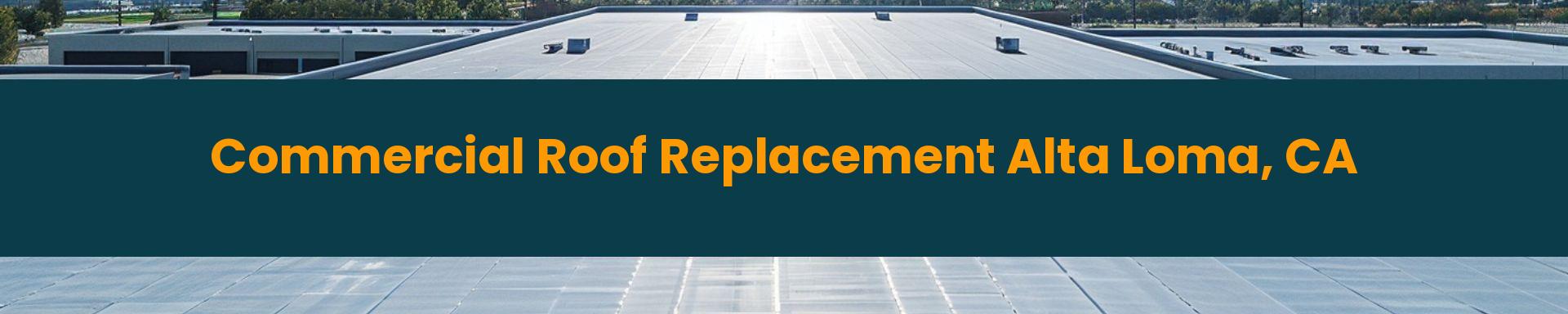
Commercial Roofing Rancho Cucamonga delivers system-led commercial roof replacement in Alta Loma, California by removing failed, saturated, deteriorated, incompatible, or end-of-service-life roof assemblies and installing replacement roof systems for warehouses, logistics facilities, industrial buildings, retail properties, office buildings, multifamily structures, service-based commercial buildings, and other commercial facilities. Commercial Roofing Rancho Cucamonga scopes commercial roof replacement in Alta Loma around verified roof failure, San Bernardino County foothill exposure, Inland Empire heat load, UV-driven membrane deterioration, thermal movement across low-slope roof spans, windborne dust accumulation, rooftop equipment layout, insulation condition, drainage performance, deck stability, recover eligibility, code constraints, access sequencing, and long-term building use, ensuring the replacement roof is designed around actual performance demand rather than like-for-like material substitution, repeated patching, or premature coating.
The Alta Loma-specific replacement outcomes below show how commercial roof replacement scope is translated into verified tear-off decisions, system selection, substrate preparation, insulation correction, drainage alignment, and documented closeout across Inland Empire heat exposure, foothill wind movement, sustained UV degradation, thermal cycling, dust-loaded drainage conditions, rooftop equipment concentration, and intermittent rainfall.
- Confirmed commercial roof replacement scope in Alta Loma → membrane fatigue, repeated leak history, seam failure, flashing breakdown, ponding exposure, insulation saturation, substrate weakness, attachment failure, and end-of-service-life roof deterioration are verified against actual roof-system behaviour → commercial roof replacement targets confirmed failure conditions rather than cosmetic wear, isolated leak marks, or short-term repair symptoms.
- Commercial roof tear-off and substrate verification in Alta Loma → failed membranes, abandoned repair layers, wet insulation, deteriorated flashings, incompatible materials, overloaded roof build-ups, and unsuitable recover conditions are removed or investigated before replacement materials are installed → the new commercial roof assembly is placed over a verified, prepared, and performance-suitable substrate.
- Roof insulation replacement and drainage correction for Alta Loma buildings → saturated, compressed, displaced, damaged, contaminated, or underperforming insulation is replaced or upgraded alongside drainage slope, scupper, drain, and low-slope water-flow requirements → the replacement roof supports thermal performance, roof stability, drainage control, code alignment, and long-term system compatibility.
- Replacement system selection for Alta Loma commercial roof conditions → TPO, PVC, EPDM, metal roofing, built-up roofing, modified bitumen, recover, or full tear-off replacement strategies are matched to roof span, deck condition, rooftop equipment layout, heat exposure, UV load, drainage behaviour, building use, attachment requirements, and lifecycle expectations → the replacement roof is selected for verified Alta Loma performance risk rather than default material substitution.
- Edge, flashing, penetration, and rooftop equipment detailing during Alta Loma roof replacement → parapets, curbs, vents, skylights, HVAC penetrations, service entries, roof edges, wall transitions, drains, scuppers, and equipment-adjacent details are rebuilt where thermal movement, foothill wind, dust accumulation, and rooftop service activity create future ingress risk → replacement scope restores waterproofing continuity at the interfaces where commercial roof failure commonly concentrates.
- Commercial roof replacement closeout for Alta Loma properties → roof condition findings, tear-off notes, insulation decisions, deck preparation, installed system details, drainage observations, flashing corrections, equipment-zone work, inspection results, warranty-relevant records, and completion status are documented for owners, property managers, facility teams, insurers, tenants, and asset-planning requirements → handover, maintenance planning, claim support, and long-term roof asset control are supported.
What Commercial Roof Replacement Services Do We Provide In Alta Loma, California?
Commercial Roofing Rancho Cucamonga delivers system-led commercial roof replacement across San Bernardino County and nearby Inland Empire areas by removing failed, saturated, deteriorated, incompatible, or end-of-service-life roof assemblies and installing replacement roof systems for warehouses, logistics facilities, industrial buildings, retail centers, office buildings, multifamily properties, and other commercial facilities. Commercial Roofing Rancho Cucamonga scopes commercial roof replacement around verified roof failure, Inland Empire heat exposure, UV degradation, thermal movement, drainage performance, insulation condition, rooftop equipment layout, attachment requirements, structural deck condition, recover eligibility, code constraints, access sequencing, and long-term building use, ensuring the replacement roof is designed around actual performance demand rather than like-for-like material substitution, repeated patching, or premature coating.
- Commercial Roof Replacement: full replacement of commercial roof systems where membrane fatigue, repeated leak history, UV deterioration, heat cycling, drainage failure, insulation saturation, substrate weakness, attachment failure, or system-wide ageing confirms that continued repair, coating, or localized patching is no longer a dependable roof-management strategy.
- Flat Roof Replacement: replacement of low-slope commercial roof assemblies where ponding water, open seams, failed flashings, saturated insulation, soft substrate zones, restricted drainage, poor slope, or broad membrane deterioration prevents the flat roof from performing as a continuous waterproofing and drainage-control system.
- TPO Roof Replacement: installation of reflective TPO membrane systems with heat-welded seams, compatible insulation, secure terminations, penetration detailing, perimeter attachment, and drainage-aware layout for commercial buildings exposed to high solar load, UV stress, thermal cycling, and Inland Empire temperature swings.
- PVC Roof Replacement: installation of PVC membrane roofing where welded seam reliability, chemical resistance, moisture control, rooftop equipment compatibility, grease or contaminant resistance, and durable low-slope waterproofing are required for commercial roof replacement under sustained heat and operational exposure.
- EPDM Roof Replacement: replacement of rubber membrane roof systems where shrinkage, seam separation, puncture damage, flashing failure, edge movement, membrane thinning, or thermal expansion and contraction have broken waterproofing continuity across the commercial roof assembly.
- Metal Roof Replacement: replacement of commercial metal roof systems where panel distortion, corrosion, fastener withdrawal, seam separation, flashing breakdown, coating loss, oil-canning, or movement-related failure prevents the metal roof from maintaining weather resistance, attachment stability, and roof-system integrity.
- Built-Up Roof Replacement: replacement of aging BUR assemblies where blistering, cracking, surfacing loss, moisture intrusion, interply weakness, edge failure, alligatoring, or long-term heat exposure has reduced the redundant waterproofing value of the multi-layer roof system.
- Modified Bitumen Roof Replacement: replacement of reinforced asphalt membrane systems where split seams, granule loss, surface deterioration, movement cracking, flashing failure, ponding exposure, membrane fatigue, or repeated leak recurrence indicates end-of-service-life roof failure.
- Commercial Roof Tear-Off: controlled removal of failed membranes, abandoned repair layers, wet insulation, deteriorated flashings, incompatible materials, overloaded roof build-ups, and unsuitable recover conditions so replacement roofing can be installed over a verified and properly prepared substrate.
- Roof Insulation Replacement: replacement or upgrade of saturated, compressed, damaged, displaced, contaminated, or underperforming insulation to restore roof assembly stability, improve thermal performance, support drainage slope, meet code requirements, and ensure compatibility with the selected replacement roof system.
- Roof Deck Assessment And Preparation: inspection and preparation of the underlying deck to identify rust, moisture damage, deflection, fastener withdrawal, weak substrate zones, damaged sheathing, attachment limitations, load concerns, or structural issues before the replacement roof assembly is installed.
- Commercial Roof Recover Evaluation: assessment of whether recover is viable by verifying existing roof condition, trapped moisture risk, insulation stability, deck capacity, drainage performance, attachment requirements, added load, material compatibility, and code limitations before deciding between recover and full tear-off replacement.
Need help with a commercial roof replacement project in Alta Loma, California?
When Does An Alta Loma Commercial Roof Need Replacement Instead Of Repair?
Commercial roof replacement in Alta Loma is required when roof-level investigation confirms that the existing roof assembly can no longer maintain waterproofing continuity, manage drainage, resist Inland Empire heat exposure, accommodate thermal movement, support rooftop equipment demand, or remain dependable under San Bernardino County foothill conditions. Across Alta Loma commercial properties, including warehouses, logistics facilities, industrial buildings, retail properties, office buildings, multifamily structures, and service-based commercial assets, replacement becomes necessary where membrane failure, repeated leak recurrence, saturated insulation, flashing collapse, deck weakness, attachment failure, or unsuitable recover conditions show that repair, coating, or partial restoration would only extend an already failing roof system.
The Alta Loma-specific replacement triggers below show when a commercial roof has moved beyond repairable defect control and requires commercial roof replacement.
- The roof membrane has reached end-of-service-life condition. UV degradation, Inland Empire heat, surface cracking, shrinkage, blistering, seam fatigue, coating loss, puncture damage, or widespread membrane brittleness can prevent the roof covering from performing as a continuous waterproofing layer. Commercial roof replacement becomes necessary when the membrane field can no longer be dependably repaired in sections.
- Leak recurrence continues after repeated patching or sealant work. Where prior repairs have failed to stop water entry, the active failure is often embedded in the wider membrane, flashing, insulation, drainage, or substrate relationship. Replacement is required when recurring leaks prove that localized repair is no longer addressing the actual roof-system failure.
- Drainage failure is creating ponding, saturation, or recurring moisture stress. Dust-loaded drains, restricted scuppers, poor slope, low-slope geometry, blocked discharge paths, overloaded outlets, or intermittent rainfall can leave standing water across the roof surface. Commercial roof replacement becomes necessary when drainage correction must be built into the roof assembly, insulation layout, and discharge strategy rather than handled as routine clearing.
- Insulation below the roof surface is wet, compressed, displaced, or underperforming. Saturated or damaged insulation can keep leaks active, distort drainage, reduce thermal performance, increase concealed load, and undermine any new membrane placed above it. Replacement is required where insulation condition must be exposed, removed, upgraded, or reconfigured before the roof can perform reliably.
- Thermal movement has compromised seams, edges, fasteners, or flashings. Alta Loma heat cycles can pull at membrane laps, perimeter details, curb flashings, roof edges, attachment points, and equipment transitions across large commercial roof spans. Commercial roof replacement becomes necessary where movement-related failure is distributed through the assembly rather than confined to one repairable detail.
- Flashing, penetration, and perimeter details are failing as part of the wider roof system. Parapets, curbs, vents, skylights, HVAC penetrations, wall transitions, service entries, drains, scuppers, and roof edges can lose continuity when ageing materials, rooftop traffic, wind exposure, and heat movement act together. Replacement is required when these details need to be rebuilt as part of a new roof assembly rather than resealed individually.
- Rooftop equipment zones are repeatedly damaging the roof assembly. HVAC curbs, pipe supports, equipment pads, access paths, service routes, and maintenance areas can create abrasion, punctures, compression, vibration wear, flashing gaps, and recurring leak points. Commercial roof replacement becomes necessary where equipment-zone protection, walk pads, curbs, penetrations, and service detailing must be integrated into the replacement design.
- The roof deck or substrate cannot support dependable replacement performance without correction. Rust, moisture damage, soft decking, deflection, deteriorated sheathing, weak substrate zones, fastener withdrawal, or attachment limitations can make continued surface repair unreliable. Replacement is required where the roof assembly must be opened, verified, prepared, and corrected before new materials are installed.
- A recover is not suitable because concealed risk remains too high. Recover may be inappropriate where trapped moisture, excessive roof layers, poor drainage, insulation instability, incompatible materials, deck-capacity limits, attachment limitations, or code restrictions prevent a reliable overlay. Commercial roof replacement becomes necessary when full tear-off is the only responsible route to remove hidden failure and install a verified assembly.
- The existing roof no longer supports the building’s operational, insurance, energy, or lifecycle requirements. Warehouses, logistics buildings, industrial facilities, retail properties, offices, and multifamily structures may need replacement when roof condition, tenant expectations, equipment loads, energy goals, maintenance costs, storm-readiness expectations, or asset-planning requirements exceed what the existing system can provide.
In Alta Loma, commercial roof replacement becomes necessary once investigation confirms that membrane deterioration, recurring leak failure, drainage breakdown, insulation saturation, thermal movement damage, flashing collapse, equipment-zone wear, deck instability, recover unsuitability, or obsolete roof configuration cannot be corrected through continued patching, coating, or partial restoration, making replacement the responsible pathway for restoring controlled, durable, and performance-aligned commercial roof protection.
Need help with a commercial roof replacement project in Alta Loma, California?
When Should Alta Loma Property Owners Plan A Commercial Roof Replacement Assessment?
An Alta Loma commercial roof should be assessed for replacement when verified roof conditions show that the existing assembly can no longer maintain waterproofing continuity, discharge water reliably, resist Inland Empire heat exposure, accommodate thermal movement, support rooftop equipment demand, or remain dependable under San Bernardino County foothill conditions. In Alta Loma, this most often affects warehouses, logistics facilities, industrial buildings, retail properties, office buildings, multifamily structures, service-based commercial buildings, and other commercial facilities where UV-driven membrane ageing, foothill wind movement, dust-loaded drainage, low-slope roof spans, rooftop equipment layouts, insulation condition, deck stability, and intermittent rainfall can determine whether repair, coating, recover, tear-off, or full replacement is the correct route. Where the roof membrane has become brittle, cracked, blistered, shrunken, punctured, split at seams, or repeatedly compromised by UV exposure and heat cycling, commercial roof replacement in Alta Loma becomes necessary because the roof covering can no longer operate as a dependable waterproofing layer. Where leaks continue after patching, sealant work, coating repairs, or partial flashing correction, replacement assessment is required because the active failure may be distributed through the membrane field, flashing network, insulation condition, drainage layout, attachment system, or supporting substrate rather than isolated to one visible leak point. Where drainage performance is failing because dust accumulation, restricted drains, blocked scuppers, poor slope, overloaded outlets, low-slope geometry, or intermittent rainfall has created ponding, saturation risk, or recurring moisture exposure, replacement planning should verify whether drainage correction must be built into the new roof assembly. Where insulation is saturated, compressed, displaced, contaminated, or thermally underperforming, commercial roof replacement becomes necessary because a new membrane cannot perform reliably over unstable or moisture-compromised insulation. Where thermal movement has pulled at seams, laps, fasteners, edge details, parapets, curbs, wall transitions, or equipment penetrations across large roof spans, replacement assessment is needed to rebuild the assembly with compatible materials, secure attachment, and movement-aware detailing.
Where rooftop equipment zones, HVAC curbs, pipe supports, service routes, skylights, vents, access paths, drains, scuppers, parapets, roof edges, and wall transitions show recurring wear, flashing separation, puncture exposure, compression damage, or water-entry risk, coordinated replacement is required because these details must be integrated into the replacement system rather than resealed as isolated defects. Where deck rust, moisture damage, soft substrate zones, fastener withdrawal, deflection, deteriorated sheathing, load concerns, or attachment limitations exist beneath the visible roof surface, the deck must be verified and prepared before replacement materials are installed. Where recover is being considered, replacement assessment must determine whether trapped moisture, added load, code limitations, drainage weakness, insulation instability, material incompatibility, or deck capacity makes full tear-off the responsible option. Commercial Roofing Rancho Cucamonga assesses Alta Loma commercial roofs against verified replacement evidence so the correct pathway is determined by roof age, failure history, membrane condition, insulation moisture, drainage behaviour, deck stability, rooftop equipment layout, recover eligibility, code constraints, access sequencing, and long-term facility use rather than surface wear, like-for-like assumptions, or repeated short-term repair. If your building in Alta Loma has recurring leaks, end-of-life membrane deterioration, saturated insulation, ponding water, flashing failure, rooftop equipment-zone damage, deck concerns, unsuitable recover conditions, or uncertainty over whether repair or coating can still remain dependable, request a commercial roof replacement assessment to identify the correct replacement, recover, tear-off, insulation, and deck-preparation pathway.
Need help with a commercial roof replacement project in Alta Loma, California?